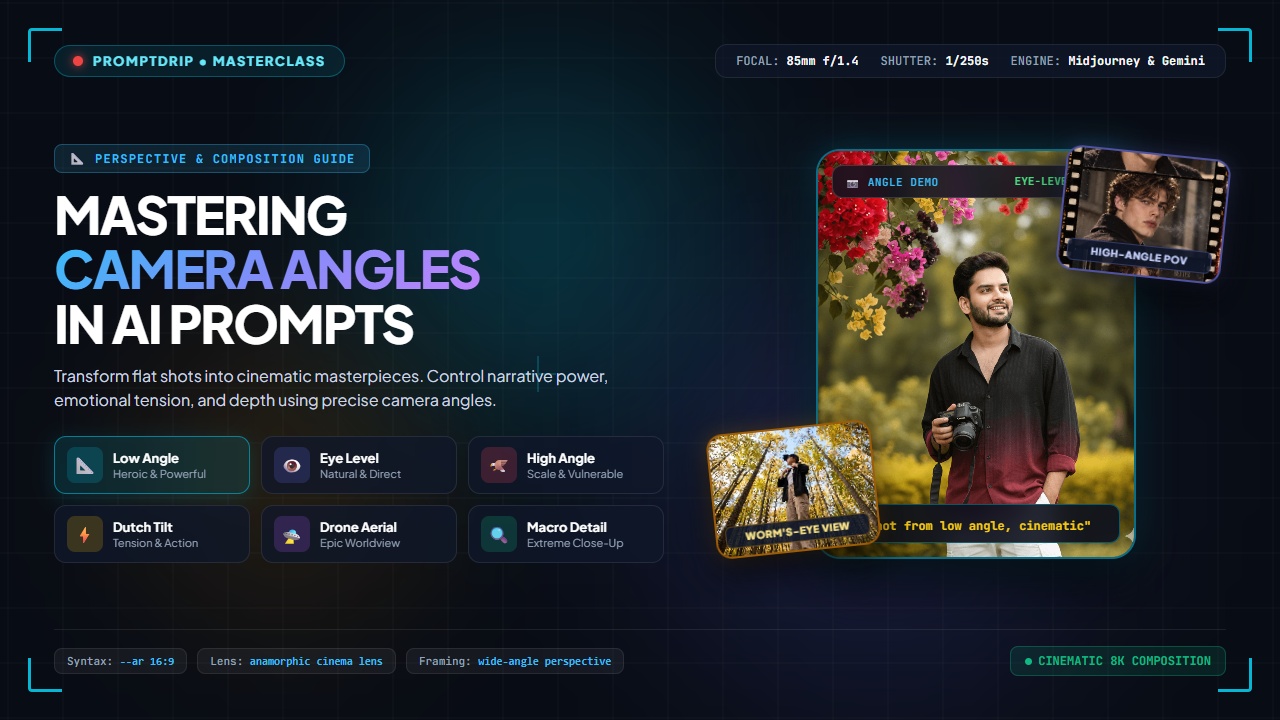


Have you ever stared at an AI-generated portrait and immediately thought: "Something looks completely fake here"? It’s almost universal. The skin looks like polished porcelain or molten wax, the eyes stare into the distance with a glassy, soulless glaze, and the hands look like they were modeled out of clay. That unpolished "plastic sheen" is the signature of amateur AI prompting. But here is the secret that veteran prompt engineers know: modern generative models like Google Gemini (Imagen 3) and Midjourney v6 don't need buzzwords like "hyper-detailed" or "photorealistic 8K". In fact, spamming those hollow marketing adjectives actually degrades your image by skewing the diffusion model's latent noise space toward oversaturated CGI video game renders and airbrushed stock photography.
In this comprehensive, 2026-tested masterclass, we will deconstruct the exact mechanics of true photographic realism. Whether you are generating aesthetic personal avatars for social media, corporate executive headshots for LinkedIn, or high-fashion magazine editorials, you will learn the camera optics, dermatological micro-textures, optical lighting rigs, and negative prompting matrices that force the AI to render human portraits indistinguishable from real Canon or Sony mirrorless RAW photographs.
Words like "smooth skin", "flawless", and "hyper-realistic" trigger AI training weights associated with digital airbrushing, beauty filters, and 3D CGI sculptures. To achieve true human authenticity, explicitly prompt for micro-imperfections: visible vellus facial hair, subtle skin pores, micro-creases, and natural skin asymmetry.
1. The Core 5-Layer Prompt Architecture
High-performing prompts aren't random strings of flattering adjectives. They are structured photographic scripts that guide the neural network through five sequential visual priorities. When prompting in Gemini or Midjourney, organize your prompt tokens in this exact hierarchy:
- Subject & Demographics: Age, heritage, facial structure, expression, and gaze vector (e.g. "A 28-year-old French woman with natural freckles, warm contemplative hazel gaze, looking slightly off-camera").
- Lighting Architecture: Quality, direction, and color temperature of the key light and fill light (e.g. "Soft directional window lighting with warm 4500K morning sunlight, gentle fill from white reflector"). Check our full breakdown in our Cinematic Lighting Handbook.
- Camera & Lens Parameters: Optical focal length, aperture f-stop, and sensor depth of field (e.g. "Shot on 85mm f/1.4 prime lens, shallow depth of field, creamy background bokeh, sensor ISO 100").
- Environment & Context: Atmospheric setting and background elements that ground the subject (e.g. "Interior Parisian apartment, blurred neutral beige linen curtains in background"). Explore our Aesthetic & Retro Prompts for mood inspiration.
- Micro-Textures & Materials: Fabric weave, pore-level dermal detail, catchlights in the cornea, and hair flyaways.
2. Camera Optics: Why Lens Choice Dictates Facial Geometry
The single biggest mistake beginners make is ignoring optical focal length. In real-world portrait photography, a 24mm wide-angle lens placed close to a face causes barrel distortion, making the nose appear unnaturally bulbous and bulging the forehead. Conversely, a telephoto lens compresses facial features, flattening depth and slimming the silhouette.
Diffusion models understand optical characteristics exceptionally well because their training dataset includes millions of EXIF metadata tags from professional photography archives (such as 500px, Flickr, and Unsplash). Here are the three focal lengths you must memorize for portraiture:
| Focal Length & Aperture | Facial Perspective | Best Use Case |
|---|---|---|
| 85mm f/1.4 or f/1.8 | Zero barrel distortion, flattering jawline compression, lush creamy background separation. | Studio portraits, beauty editorial, Trending Portraits. |
| 50mm f/1.8 ("Nifty Fifty") | Natural human eye perspective, balanced field of view, organic intimate presence. | Lifestyle candid shots, cafe scenes, casual portraits. |
| 35mm f/2.0 or f/2.8 | Slight environmental expansion, captures upper torso and surrounding interior architecture. | Street fashion, environmental portraits, corporate workplace. |

3. Unlocking Dermal Realism: Skin Pores, Vellus Hair & Catchlights
To banish the "AI wax museum" look forever, your prompt vocabulary needs to bridge dermatological and optical terminology. Instead of telling the AI what the image should feel like, describe the physical elements that exist on the skin surface:
- "Natural sub-surface scattering (SSS)": This instructs the AI to simulate how light penetrates translucent human skin tissue (like ears, nostrils, and cheekbones) and scatters beneath the dermis, creating the warm blood-rich glow characteristic of living humans.
- "Subtle micro-freckles and pores": Forces the diffusion model to preserve high-frequency texture across the T-zone and bridge of the nose instead of smoothing it away into plastic.
- "Catchlights in pupils from octabox softbox": Human eyes look dead in AI without catchlights (the specular reflection of light sources). Specifying the geometric shape of the light reflection (e.g. octabox or window frame) breathes instant soul into the subject.
- "Individual hair flyaways and baby hairs": Real human hair is messy and dynamic. Perfectly glued hair looks fake. Adding "subtle flyaway hairs caught in rim light" elevates realism immediately.
8K editorial close-up portrait of a 26-year-old Scandinavian woman, natural textured skin with visible fine pores and subtle freckles across nose bridge, soft hazel eyes with clear octabox catchlights, relaxed neutral expression, loose auburn hair with natural flyaways. Shot on Sony A7R V, 85mm f/1.4 G Master lens, soft diffused Rembrandt lighting from 45-degree angle, subtle sub-surface scattering, shallow depth of field, creamy muted beige background, color graded in DaVinci Resolve, clean RAW photograph style --ar 16:9 --v 6.0 --style raw
4. Male Portraiture: Jawlines, Scruff & Rugged Textures
When generating male portraits—such as our trending Handsome Man at Mountain Resort or corporate portraits like Corporate Confidence Headshot—the AI often tends to over-beautify men, giving them makeup and airbrushed cheekbones.
To maintain masculine ruggedness and natural gravitas, emphasize hard directional light, stubble texture, and authentic wardrobe creases. Check our full curated collection in Boys AI Prompts and Professional AI Prompts.
Medium close-up portrait of a 34-year-old confident executive man, sharp chiseled jawline, neat 3-day stubble with individual beard hair follicles visible, piercing grey-blue eyes, wearing a tailored charcoal wool blazer over dark merino turtleneck. Shot on Canon EOS R5 with RF 85mm f/1.2L lens, directional key light with gentle negative fill for subtle shadow sculpting, natural skin tones, no airbrushing, modern architectural glass office blurred in background, moody corporate editorial look --ar 16:9 --v 6.0
5. The 5 Fatal Prompting Traps That Ruin Human Faces (And How to Fix Them)
Even skilled creators make subtle errors that trigger the uncanny valley. Here are the five most common traps and their instant prompt fixes:
- Trap 1: The "Uncanny Smile" (Excessive Teeth & Gums): Asking for a "smiling happily" prompt often results in unnatural horse-like teeth with duplicate premolars. Fix: Prompt for "subtle closed-lip smile", "serene relaxed lips gently parted", or "warm contemplative expression".
- Trap 2: The "Alien Ear" Melting Cartilage: In full-body or side-profile shots, ears are notorious for melting into hair. Fix: Specify "hair tucked neatly behind ear, distinct anatomical ear cartilage and earlobe", or use a headshot framing where the camera angle keeps both ears in clear focus.
- Trap 3: Mannequin Hand Syndrome: Extra fingers, mutated knuckles, and rubbery skin on hands happen when hands are positioned unnaturally near the face without context. Fix: Anchor hands with interacting objects: "hand casually holding a ceramic coffee cup", "fingers resting in trench coat pocket", or "hand adjusting wristwatch". Physical purpose forces the neural network to render realistic finger articulation.
- Trap 4: Symmetrical Clone Syndrome: Real human faces are subtly asymmetrical. Completely symmetrical AI faces look deeply robotic. Fix: Introduce an asymmetric element: "slight tilt of the head, 3/4 quarter profile angle, asymmetric loose hair parting".
- Trap 5: Flat Flash Glaze: When lighting is not specified, AI default lighting flattens the nose and cheekbones. Fix: Introduce a 45-degree angle offset key light with a negative fill side to preserve facial contours.
6. Step-by-Step Prompt Evolution: From Boring 3D Render to Cannes-Grade Masterpiece
To understand how token layering transforms quality, observe how a prompt matures across four developmental iterations:
7. The Master Anti-Plastic Negative Prompt Matrix
Positive prompting tells the AI what to construct; negative prompting purges the synthetic garbage from the latent generation. If your AI platform supports negative prompts (like Stable Diffusion, Flux, or Midjourney --no parameters), keep this master exclusion list pinned to your workflow:
Conclusion: Build Your Signature Prompt Formula
Achieving photorealism in 2026 is no longer about blind luck or hitting the "generate" button fifty times. It is a systematic, repeatable creative discipline combining optical photography fundamentals, anatomical micro-textures, and directional lighting. Bookmark this guide, test the prompt scripts on PromptDrip, and explore our thousands of pre-calibrated Trending 8K AI Prompts to level up your creations today!